
Liquid chromatography-tandem mass spectrometry (LC-MS/MS) technology paves the way in analytical science to test for known and unknown poly- and perfluoroalkyl substances (PFAS) in drinking water, wastewater and even soil. The sensitivity and robustness of LC-MS/MS make it an ideal choice to analyze these ubiquitous and persistent pollutants quantitatively.
PFAS refers to a group of synthetic chemicals, such as perfluorooctanoic acid (PFOA) and perfluorooctanesulfonic acid (PFOS), and many other substances. PFAS testing is important because more than 3,000 types of PFAS threaten human health and the environment.1 These chemicals have been in commercial production since the 1940s to make surfaces in products such as aqueous film-forming foams (AFFF), nonstick kitchenware and adhesives resistant to water and grease.
The physicochemical properties that make these substances important in a variety of industrial and consumer products are the same characteristics that make them a concern: they don't break down. Technical mixtures can be produced from different manufacturing processes and can, therefore, contain various species, including different chain lengths, branched-chain isomers or precursor compounds. This means these chemicals are highly persistent, lingering and accumulating over time in humans, animals and the environment, which explains why they are referred to as "forever chemicals."
In recent years, environmental scientists and toxicologists have been studying PFAS along with prominent legacy substances such as PFOA and PFOS. As our understanding grows, we have learned that PFAS encompasses a far greater number of compounds than previously known, and that number continues to expand. In addition, PFAS alternatives such as hexafluoropropylene oxide dimer acid (HFPO-DA), better known as GenX, are also contaminants of emerging concern (CEC).
Exposure to PFAS comes primarily from drinking water, packaged food or the use of products embedded with PFAS. This is especially evident in areas where firefighting foam is used, such as in industrial sites, oil refineries, airfields and military bases.2 Because PFAS cannot be removed by most store-bought filters or standard wastewater treatment methods, it's critical for scientists to analyze the sources—drinking water, groundwater, surface water, wastewater, soil and other environmental sources—for these chemicals at a large scale.
However, mainstream testing approaches for identifying both known and unknown PFAS come with an array of challenges:

Mass spectrometry: your tool for accurately detecting and quantifying novel PFAS and GenX compounds
When it comes to PFAS analysis, it's important to adopt best practices that minimize the potential for system contamination while successfully measuring PFAS at trace levels in various matrices such as water, soil and even food.
LC-MS/MS is ideal for the monitoring of PFAS in environmental samples due to its:
LC-MS/MS has transformed the path to detecting, quantifying and understanding PFAS. At SCIEX, we know that when your lab faces lots of samples and impending deadlines, you can't afford an unreliable instrument system. Whether your laboratory needs to identify new PFAS or routinely quantify them, LC-MS/MS PFAS testing solutions from SCIEX will help you maximize productivity while consistently providing you with the high-quality data you need.
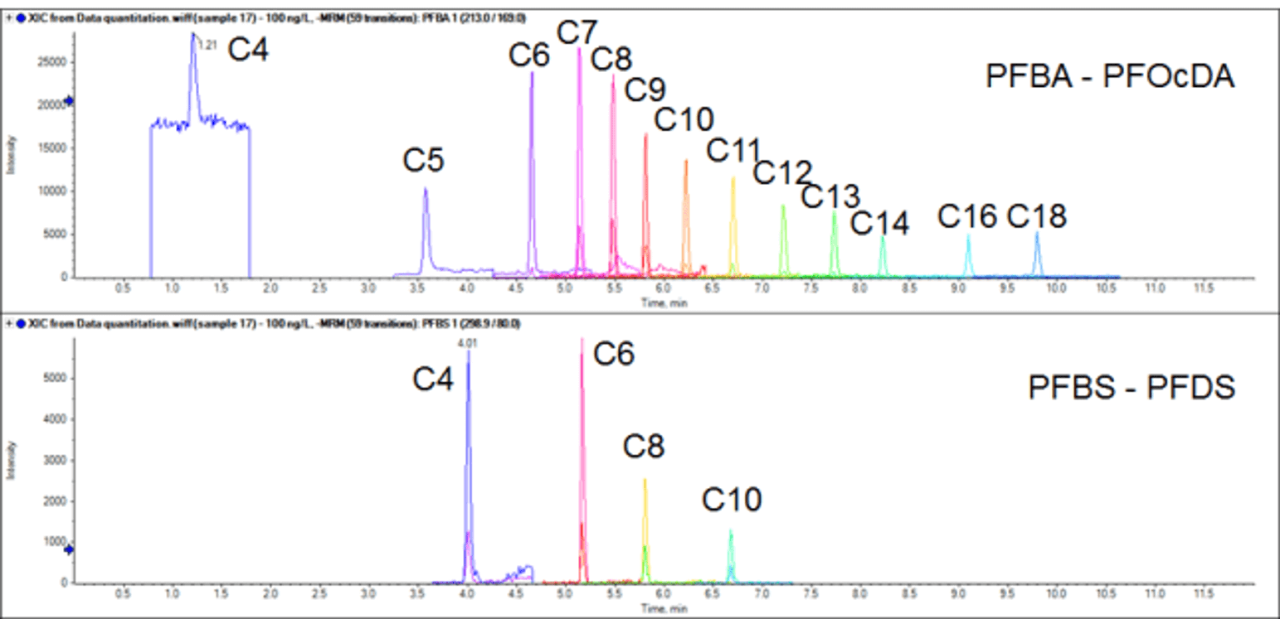

Achieve reporting limits of 2 ng/ L with excellent linear dynamic range and support EPA 533 and UCMR5 requirements

Detect 14 PFAS compounds in drinking water to EPA Method 537.1 guidelines in just 10 minutes

Meet regulatory limits by characterizing and quantifying PFAS and GenX in water using liquid chromatography-mass spectrometry.
Learn more about how the selectivity and specificity of accurate mass QTOF technology can help provide the edge you need to quickly identify both suspect and unknown compounds.
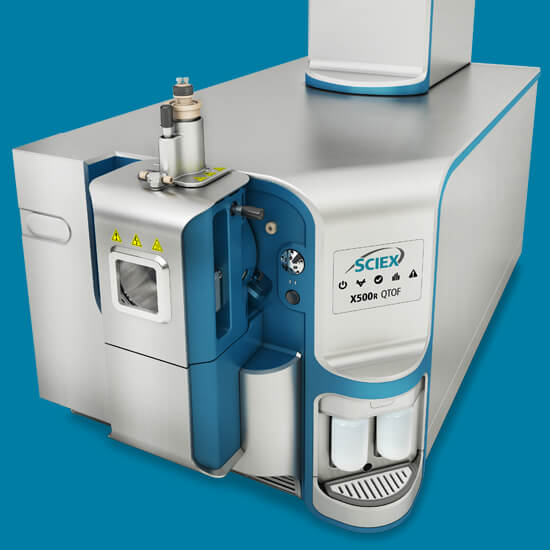
This easy-to-use accurate mass spectrometer system analyzes data faster using the power of SWATH acquisition.

This all-in-one software lets you acquire, process and analyze data, and even generate reports.
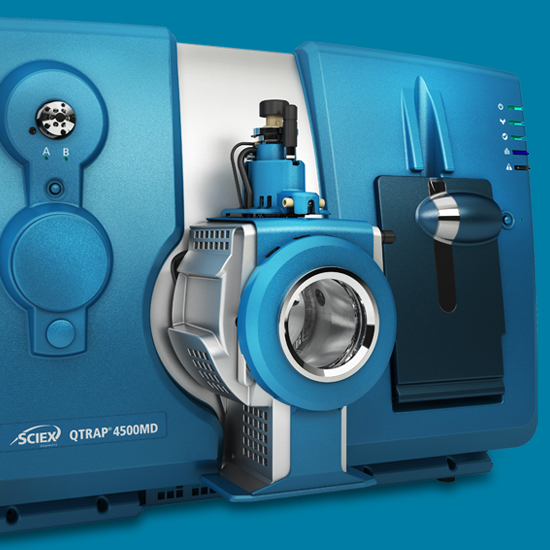
Employ the MRM sensitivity of a triple quadrupole system to get even better identification and quantification.

Browse through an extensive, verified library of more than 250 PFAS fluorochemicals and their metabolites supported by over 600 high-resolution MS/MS spectra.
Get the tools and protocols you need for fast, robust and accurate quantification of trace PFAS levels in drinking water.
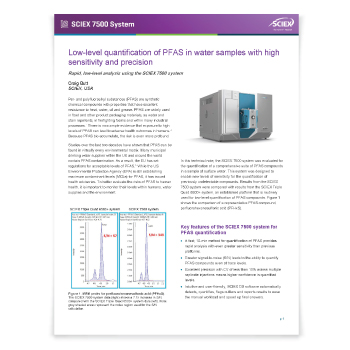
A highly sensitive, comprehensive quantitative method developed for a suite of PFAS compounds